UNOOSA calls for strengthened legal frameworks as space activities accelerate
Date: 2026-04-16
By: Nana Appiah Acquaye
The
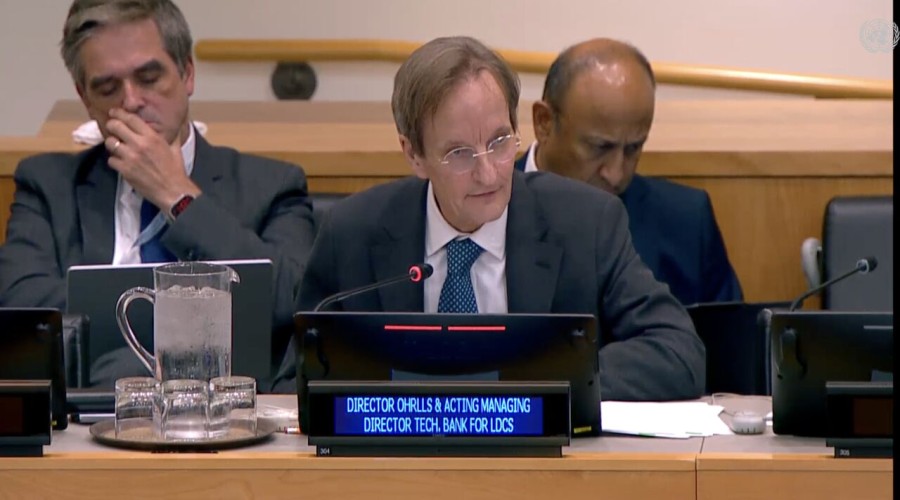
Director of the United Nations Office for Outer Space Affairs (UNOOSA), Aarti
Holla-Maini, has called for intensified global efforts to strengthen legal and
policy frameworks governing outer space as the pace of space activities
continues to accelerate.
Speaking
at the 65th session of the Legal Subcommittee of the Committee on the Peaceful
Uses of Outer Space (COPUOS), Holla-Maini underscored the Subcommittee’s
central role in shaping international space governance, describing it as “the
custodian of one of humanity’s greatest collaborative achievements.”
She
noted that as the international community approaches the 60th anniversary of
the Outer Space Treaty in 2027, there is an urgent need to advance legal work
on key issues, including the peaceful and sustainable use of space resources
and enhanced information-sharing under Article XI of the treaty.
The
session is expected to address critical areas such as the development of
principles for space resource utilization, frameworks for safe lunar
operations, and broader discussions on space safety amid the expansion of
commercial satellite constellations and renewed lunar exploration efforts.

Holla-Maini
emphasized the importance of anticipatory diplomacy, urging member states to
remain proactive in adapting legal and regulatory systems to keep pace with
technological advancements in the sector. She highlighted that the outcomes of
the current session will play a significant role in guiding future space
exploration and ensuring long-term sustainability.
Despite
the growing demand for support, she acknowledged that UNOOSA is operating under
increasing resource constraints, including reduced staffing and financial
pressures affecting the United Nations system. She called on member states to
provide additional financial and institutional support to enable the office to
meet its expanding mandate.
The
Director also outlined ongoing capacity-building efforts under the Global Space
Law Project, which has provided advisory support to several countries,
including Ghana, Vietnam, Cambodia, and Singapore. She noted rising demand for
such assistance, with over 60 member states seeking support in developing
national space legislation and regulatory frameworks.
In
addition, UNOOSA continues to enhance tools such as the ASTRO database, which
provides access to international and national space law instruments, supporting
greater coherence and harmonization across jurisdictions.

Holla-Maini
further highlighted recent milestones, including the registration of thousands
of space objects and increased reporting on re-entries, underscoring the
growing complexity of space activities and the need for robust governance
systems.
She
also pointed to collaborative achievements in Africa, including the recent
launch of a jointly developed Earth observation instrument by Egypt, Kenya, and
Uganda to the International Space Station, describing it as a significant step
in regional cooperation and climate monitoring.
Looking
ahead, UNOOSA plans to host additional regional workshops on space law and
sustainability, as well as its third lunar conference later this year, aimed at
fostering dialogue and strengthening international collaboration.
Holla-Maini
concluded by urging member states to actively support ongoing reforms within
COPUOS and contribute to new initiatives such as the Space Cooperation for
Development Fund, designed to ensure that space technologies contribute
meaningfully to sustainable development globally.