By: Robert
Kwaku Annor
The Chairman of the
Governing Council of the Kwame Nkrumah University of Science and Technology
(KNUST), Akyamfour Asafo Boakye Agyemang-Bonsu, has commended research being
undertaken by the university’s Responsible AI Lab (RAIL) and urged researchers
to focus on scaling their innovations for wider societal impact.
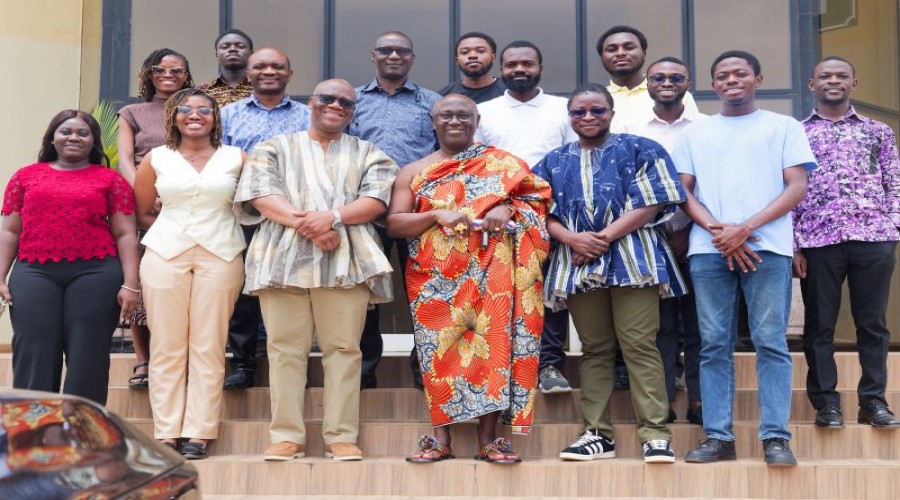
Agyemang-Bonsu made the
remarks during a working visit to RAIL, where he toured the facility,
interacted with researchers and reviewed ongoing projects aimed at applying
artificial intelligence to real-world challenges.
Prof. Jerry John Kponyo,
Principal Investigator and Scientific Director of RAIL, welcomed the Council
Chairman and outlined the laboratory’s role under the KNUST Engineering
Education Project (KEEP), which seeks to strengthen postgraduate research
through dedicated specialised research facilities.
Prof. Kponyo explained that
RAIL was established as part of a broader initiative to provide postgraduate
students with dedicated environments for specialised research. Other facilities
under the initiative include the Quantum Lab, Power Systems Lab and Renewable
Lab.
During the visit,
researchers presented projects focusing on the application of AI in healthcare
and Ghana’s traditional justice system. Musah Ibrahim Ali presented research on
the use of AI in the diagnosis and management of rare diseases, as well as an
Automatic Speech Recognition system developed for Akan and designed to support
transcription of proceedings in Ghana’s customary courts.
The speech recognition
project seeks to automate the transcription of court proceedings while
addressing the challenges associated with code-switching in Ghanaian languages.
The Council Chairman
expressed particular interest in the traditional court transcription project,
which he had previously encouraged the laboratory to develop.
He commended the researchers
for working on solutions to practical challenges facing society and called for
stronger collaboration across academic disciplines to enhance the impact of the
research.
He recommended collaboration
between RAIL and departments including Languages and Linguistics, Physics, the
Medical School and Optometry to facilitate cross-disciplinary research and
expand the application of AI solutions.
Agyemang-Bonsu also
challenged the laboratory to move beyond academic excellence towards what he
described as “eminence” by taking successful research outputs beyond the
university and scaling them for broader societal use.
He urged the researchers to
examine KNUST’s eight thematic areas and identify opportunities where
artificial intelligence can contribute to addressing challenges and creating
practical solutions.
The Council Chairman said
researchers should view themselves as problem-solvers whose work can contribute
directly to society, encouraging them to pursue research with impact beyond
academic qualifications.
The visit provided an
opportunity for KNUST leadership to assess RAIL’s progress and reinforce the
university’s commitment to research, innovation and the development of AI
solutions addressing Ghana’s development challenges.