Europe’s deforestation law tests Ghana’s cocoa farmers, spares its gold miners
Date: 2026-08-13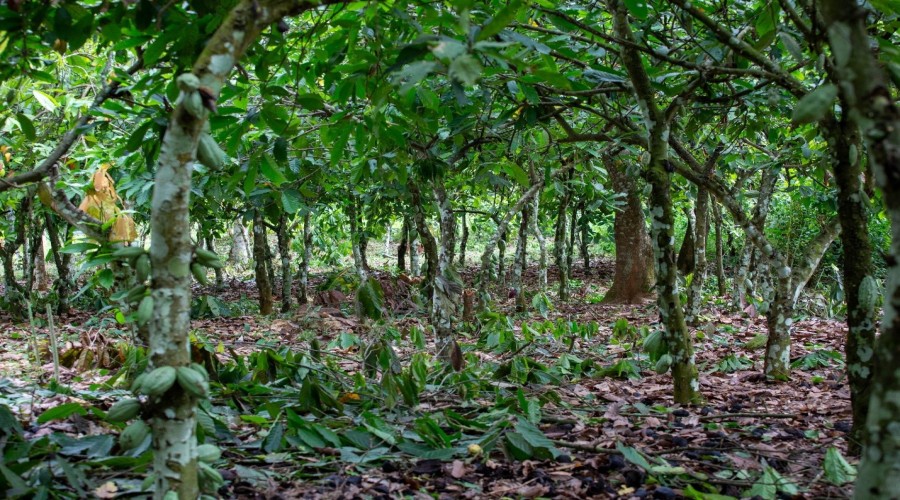
By: Afia Agyapomaa Ofosu/Marta Abbà
At daybreak in Begoro, in Ghana’s Eastern Region, Sammy Takyi walks slowly between rows of young cocoa trees. The soil is still cool. Broad plantain leaves hang above the tender seedlings, filtering the early morning light and shielding them from the heat that will come later in the day.
For
five years, his five-acre farm has tested his patience. Cocoa is not a crop
that yields rewards quickly. It requires four to five years of care before the
first meaningful harvest. During those long waiting seasons, Sammy plants
plantain among the cocoa trees.
“You
don’t just plant cocoa and wait,” he says. “The plantain feeds you and protects
the cocoa. That is how you survive the years before harvest.”
His
family processes cocoa into chocolate and food spices. The crop is woven into
his family’s history. Yet two years ago, he stood on this same land and
considered cutting everything down.
“I
was tired,” he admits. “The condition of cocoa farmers is discouraging. There
are no real incentives. You wait for years, and when the harvest comes, the
money does not reflect the effort.”
Why Cocoa Is Losing Its Hold on Farmers

Cocoa pods on a mature tree in Ghana’s Eastern Region, where low
returns and illegal gold mining pose major challenges. Photo: Festus
Randy Jackson-Davis
His
thoughts are not unusual in Ghana’s cocoa-growing communities. Across the cocoa
belt, many farmers are quietly weighing the same decision, especially as
illegal gold miners move closer to their lands with immediate cash offers.
Illegal
gold mining, known as galamsey, has destroyed nearly 9,000 hectares of Ghana’s
legally protected forest reserves. That
is according to a Forestry Commission assessment presented on February 24,
2026, and discussed
by CEO Dr. Hugh Brown with journalists on March 4.
The
data, derived from satellite imagery covering 45 forest reserves and one
national park, showed that a total of 8,923.8 hectares had been damaged as of
December 31, 2024. This is equivalent to approximately 12,500 FIFA-standard
football fields.
At
the University of Ghana, Prof. Peter Bilson Obour, Senior Lecturer in the
Department of Geography and Resource Development, explains that, beyond illegal
mining, some recommended cocoa farming practices can also frustrate farmers.
“Farmers
are encouraged to integrate other trees with cocoa for shade and ecological
benefits,” he says. “But some of these trees become breeding grounds for pests
and diseases. Instead of helping, they create more work and cost for the
farmer.”
There
is also the issue of control over what stands on the farm.
“If
a farmer plants timber trees and later wants to cut one, the process is not
simple. You need permission. Many farmers feel it is unfair to go through
bureaucracy to cut a tree on their own land.”
Over
time, these obstacles shape how farmers perceive their farms. Trees that were
intended to be assets begin to feel like liabilities. For some, this becomes
part of the reason they listen when miners arrive.
When Gold
Reaches the Cocoa Farm

The official
2025/2026 cocoa producer prices announced by COCOBOD
In
the Prestea Huni-Valley Municipality of the Western Region, Nana Boakye, a
Municipal Chief Farmer, speaks with frustration about cocoa prices.
“A
bag that used to sell at GH¢3,625 now sells at GH¢2,587,” he says. “They say
the world market price has gone down. But the hardship here has not reduced.”
He
has watched farmers make difficult choices.
“Those
who sold their farms completely have already spent the money and are left with
nothing,” he says. “On the other hand, those who partnered with illegal miners
are still taking money from their land.”
To
him, the deeper problem lies in outdated systems.
“Many
of the laws guiding cocoa farming have not changed much over the years.
Enforcement is weak. Farmers feel abandoned.”
An Oxfam
analysis published in 2023 found that many Ghanaian cocoa farmers continue
to earn below a living income. In such conditions, the promise of quick money
from mining becomes increasingly difficult to ignore.
Dr.
Kojo Ahiakpa, an agribusiness expert, sees the crisis as the intersection of
weak policy coordination, global trade rules, and environmental degradation.
“The
laws around cocoa, forests, and mining do not connect well,” he explains. “That
makes enforcement difficult and leaves gaps that are being exploited.”
With
annual production averaging about 800,000
tonnes in recent years, Ghana remains the world’s second-largest cocoa producer
after Côte d’Ivoire. To date, the country exports most of its cocoa beans in
raw form and captures only a small share of the value generated by chocolate
manufacturing abroad.
At
the same time, gold has overtaken cocoa as Ghana’s leading export commodity.
Switzerland remains one of the principal destinations for Ghanaian gold
exports, handling a significant portion of the country’s gold trade. It is
within this context that international regulations are beginning to reshape the
cocoa sector.
The EUDR Meets
Ghana's Cocoa Reality

Ghana’s cocoa vs. gold export revenues in billions USD, spanning
2023 through 2025 Source: Bank of Ghana & Goldbod
In
2023, the European Union adopted the European Union Deforestation Regulation (EUDR),
requiring companies importing commodities such as cocoa, coffee, palm oil, soy,
cattle, rubber, and wood into the EU market to demonstrate that these products
are not linked to deforestation. Gold, however, is not covered under the
regulation.
Dr.
Ahiakpa describes this as an imbalance with significant implications for
cocoa-producing countries.
“Cocoa
is being monitored for deforestation. Gold, which is contributing heavily to
that same deforestation, is not facing similar checks,” he said.
The
regulation requires cocoa supply chains to provide geolocation data for farms
supplying the European market.
“For
a farmer in a remote area with limited access to the internet or technology,
this creates another layer of cost and stress,” Dr. Ahiakpa said.
Martha
Rainer Opoku Mensah, a development practitioner working in Ghana’s cocoa
sector, believes women farmers are likely to bear an even heavier burden under
the EUDR.
“While
all farmers will struggle with the EUDR, women face greater barriers. Many farm
jointly with their husbands, but the land is registered in the husband’s name.
Without land ownership, they lack the collateral needed to access credit.”
She
noted that women also incur higher labour costs because many are unable to
carry out physically demanding farm tasks on their own.
“Men
can often clear their farms themselves, but women usually have to hire labour.
Spraying equipment is also too heavy for women to carry.”
Despite
these challenges, Opoku Mensah said preparations are underway to help farmers
meet the regulation’s requirements.
“The
government has introduced a cocoa management system and is investing in
capacity building. COCOBOD is training farmer organisations on the EUDR
process, beginning with cooperatives,” she said.
The
EUDR implementation timeline has been delayed
twice. Large and medium companies must now comply from December 30, 2026, while
small and micro enterprises have until June 30, 2027. Even so, its influence is
already reshaping Ghana’s cocoa sector, with COCOBOD rolling out traceability
systems and the Forestry Commission building deforestation baselines ahead of
the deadline.
Speaking
on behalf of COCOBOD Chief Executive Dr. Ransford Abbey at the Fourth EUDR
Multi-Stakeholder Event
on May 26, 2026, Eric Amengor, Deputy Director for Monitoring and Evaluation,
said, “We have put in place a system and measures that will enable companies
meet their obligations under the EUDR, including cocoa traceability and
deforestation risk assessment, and we are committed to supplying the EU market
with compliant cocoa.”
At
the same event, Elikem Kotoko, Deputy Chief Executive of the Forestry
Commission, underscored the importance of the Commission’s forest mapping
efforts, saying, “This map is not just a tool; it is a foundational resource
designed to support COCOBOD and EU operators in their due diligence efforts.”
Traceability System Under Scrutiny
The
Ghana Cocoa Traceability
System is a national digital platform that tracks cocoa beans from individual
farm plots to export. As part of this, trained field teams use GPS-enabled
devices like smartphones to record the geographic coordinates of cocoa farms.
Dr.
Carla D. Martin, President of the Board at the Institute for Cacao and
Chocolate Research, Harvard University, questioned the robustness of the
digital cocoa traceability system, flagging that gaps in implementation could
weaken its impact.
“The
EUDR has opened up a conversation that was previously quite taboo. I see some
benefit in the fact that people now openly speak about deforestation. There is
agreement that this is an issue and that we need to address it. My biggest
concern is that Ghana is more advanced than Côte d’Ivoire in its traceability
efforts. However, I am already hearing that there are ways to cheat the
system.”
“You
can sell false geolocation points and all sorts of other things. We are also
seeing that the European Union has failed to pass the legislation for two years
in a row, and that has led to a significant loss of trust,” she said.
Efforts
to get the Spokesperson’s Service (SPP), the official voice of the European
Commission, to respond to questions on the EUDR were unsuccessful. In addition,
COCOBOD had not responded to a Right to Information request seeking details on
the effectiveness of the traceability system at the time of publication.
Beyond
traceability, other experts warn that environmental risks add another layer to
the challenge. John Newell, founder of UK-based Tree2Bar, explains: “Chemical
contamination is an obvious danger, whether from heavy metals released during
mining or from substances used during extraction. These contaminants can create
long-term pollution that affects human health and the environment.”
He
adds that market access could also be affected.
“If
significant volumes of Ghanaian cocoa become unmarketable in the EU due to
non-compliance, this could put pressure on prices. Furthermore, chocolate
makers will look to other countries, such as Ecuador, for supply that meets EU
rules. Over time, this may affect how Ghanaian cocoa is seen in the market.”
Ghana
currently enjoys a strong reputation for cocoa quality. However, persistent
concerns related to mining, environmental degradation, and compliance
requirements could influence sourcing decisions by international buyers.
“As
of early 2026, there are signals from key markets such as Japan and the United
Kingdom regarding concerns over contamination linked to mining,” Dr. Ahiakpa
warns. “If they begin rejecting Ghana’s cocoa, it will create serious
instability.”
The Missing Link in the Gold Supply Chain

Developing cocoa pods on a tree in Ghana’s Eastern Region highlight
challenges posed by the EU Deforestation Regulation and mining encroachment.
Photo: Festus
Randy Jackson-Davis
Christoph Wiedmer, former President of the Society for Threatened Peoples, has researched global gold supply chains since 2012. He argues that regulations such as the EUDR are important but should also extend to minerals, including gold.
“Often
these regulations concern timber, soy, cocoa, and other products, but not
minerals,” he said. “It is important to include minerals, especially because of
the use of mercury, for example in the Amazon region. It is extremely polluting
and harmful to people.”
He
also points to the unique status of gold in global markets.
“The
problem is that gold is treated as an investment, even though much of it goes
into the jewellery sector.”
According
to Wiedmer, greater accountability is needed throughout the supply chain.
“Refiners
must be held responsible for monitoring everything. Since there is no
international legislation to regulate this, we must rely on industry
certification initiatives such as the London Bullion Market Association (LBMA) standards.
Producing countries must control gold production, and consuming countries must
ensure that only legally sourced gold can enter the market.”
Hannah
Mowat, Campaigns Coordinator at the Brussels-based NGO FERN, argues that
traceability systems are essential if regulations are to be effective.
“If
we put in place a regulation without a traceable system, the regulation is
totally useless because we don’t know how to apply it,” she said. “Switzerland
and the United Kingdom should also support these countries to develop such
systems.”
Cocoa’s Value Leaves Ghana’s Shores
In
February 2026, Ghana’s President, John Mahama, announced reforms aimed at
strengthening local control over the country’s natural resources. The proposals
include reducing raw commodity exports and expanding domestic processing.
However,
the financing arrangements underpinning Ghana’s cocoa sector present a constraint.
“Our
cocoa beans are used as collateral for funding,” the President explained.
“Financiers support the purchase of the beans and, in return, the beans must be
shipped to them.”
In
response, Ghana joined Nigeria, Côte d’Ivoire, and Cameroon in signing the
Abuja Declaration at the Cocoa Value Addition Summit in Abuja on Tuesday, July
14, 2026, establishing the Cocoa
Value Addition Alliance.
The
four nations make up about two-thirds of global cocoa output. They agreed to
end raw bean exports and to deal with buyers as a single bloc. Through the “From
Bean to Brand” initiative, the alliance will harmonize policies and
standards while boosting local processing into products such as butter and
chocolate.
This story was produced with the support of Internews’ Earth
Journalism Network.